
What did Beryl actually do to Fort Bend County?
It arrived as a Category 1 hurricane and left as a wind event. Beryl made landfall at Matagorda Bay at 3:40 a.m. on 8 July 2024 with 80 knots of sustained wind, then moved north over the western side of the Houston metro. The National Weather Service attributed Fort Bend's damage to wind rather than surge.
The county's highest measured gust was 76 mph at Sugar Land Municipal Airport, and the Weather Service noted the power failed during the strongest winds, so the true peak was likely higher. Close to 209,000 county customers lost power, about 59 percent of the county. Fort Bend also recorded the highest rainfall total of the whole event, 14.99 inches near Thompsons.
Fort Bend was not in the original federal disaster declaration on 9 July. It was added by amendment a few days later, after the state asked for its inclusion.
Why would damage still be on a roof two years later?
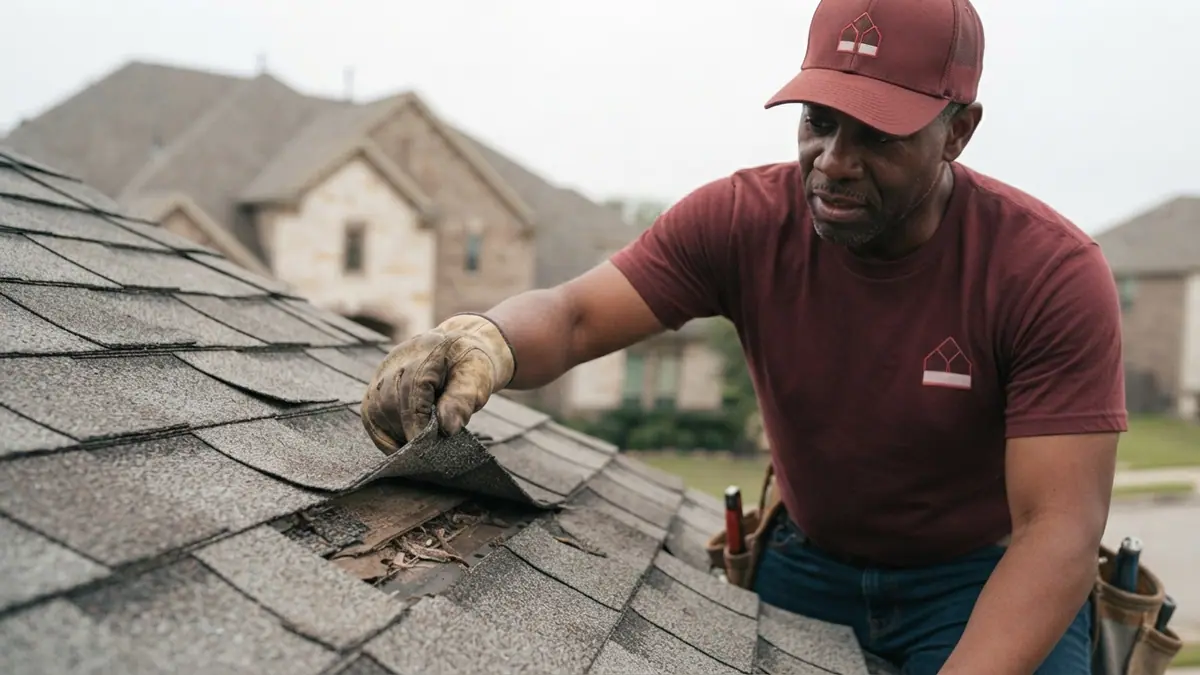
Because the most common form of wind damage leaves the shingle in place. Asphalt shingles seal to the course below along a strip of adhesive. Wind can break that bond along part of its length while the tab stays flat and looks completely normal from the ground.
Published wind-engineering research on shingle unsealing found these partial failures widespread on ordinary roofs, in patterns resembling the damage recorded in post-hurricane building assessments, and wind-tunnel testing showed partially unsealed shingles failing at speeds fully sealed ones survived. The Insurance Institute for Business and Home Safety adds that roof age itself drives unsealing, and that standard test methods do not predict real-world performance well.
So the roof that came through Beryl with nothing visibly wrong is not necessarily the roof that was there before Beryl. It is the same covering with a weaker hold on itself.
Is the recovery actually finished?
Not for everyone. Rice University's Kinder Institute surveyed more than 9,000 Greater Houston residents across Harris, Fort Bend and Montgomery counties in October and November 2025, roughly sixteen months after the storm. Six percent said their daily lives were still disrupted by Beryl, and among those still recovering, 67 percent reported property damage and ongoing repairs.
Has anything hit since?
Yes, though nothing at hurricane strength. No tropical system made landfall in Texas during the 2025 season, and none has in 2026 either. Beryl remains the most recent hurricane landfall to affect Fort Bend County.
Severe weather is a different question. The Governor issued a severe storm disaster proclamation in June 2026 covering 83 counties including Fort Bend, for an event bringing heavy rainfall, hazardous wind gusts, large hail and a tornado threat. A roof carrying partial sealant failure from 2024 has met several rounds of wind since.
What is worth doing now?
Have the covering looked at, and treat it as maintenance rather than a claim. The Texas limitations period for suing an insurer over Beryl damage ran out around 8 July 2026, two years from the date of loss. Anything found on a roof today is a repair decision and a readiness decision, not a Beryl claim.
The useful question is whether the covering will hold through the next storm season. A roofer checking for unsealed tabs works across the slope by hand, because the failure is invisible in a photograph and invisible from the driveway. Wind damage and emergency work covers what happens when the answer is no, and a documented condition report gives you a dated written record before the next system arrives.