
Fulshear shingle and flashing repair
The repairs that follow once the entry point is found.
Fulshear leak tracing and repair
Call (716) 328-9097 for roof leak repair in Fulshear, TX. Water is traced back from the ceiling stain to the opening above it, then the flashing, boot or shingle course that let it through is rebuilt. Typical Fulshear leak repairs run $360 to $1,550. The price is confirmed once the source is found, not guessed at beforehand.
Calls answered 24/7
Water enters the roof, lands on the underlayment and runs downhill along rafters until it meets a fastener, a seam or a light fixture. The stain marks where it finally dropped, which sits feet away from the entry point and usually further up the slope.
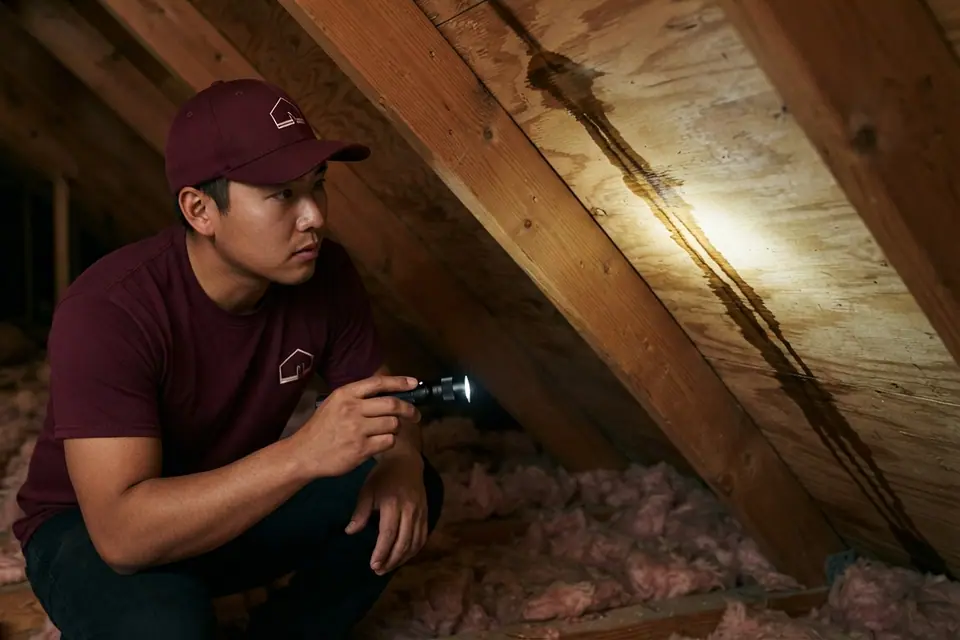
That is why a roofer starts in the attic rather than on the covering. A flashlight held low across the sheathing shows the dark tracking line water leaves behind, and following that line uphill ends at the penetration that failed.
Leaks cluster at the points where something interrupts the field of shingles.
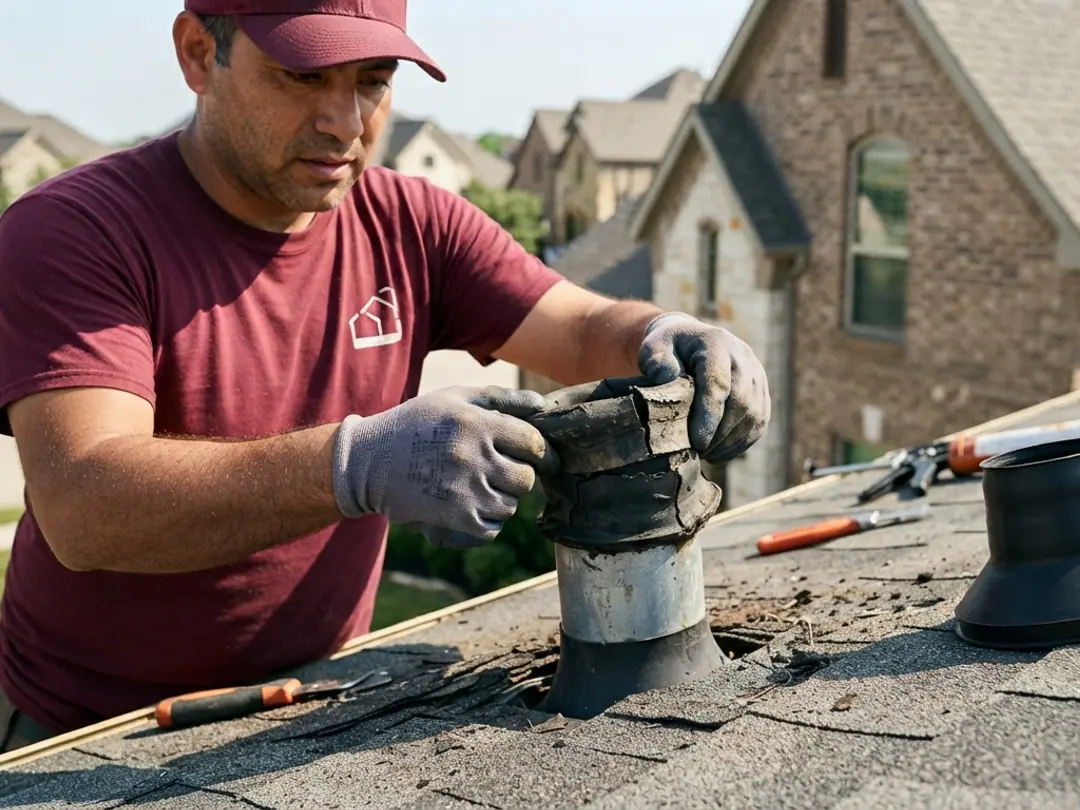
The rubber collar splits after years of UV exposure, and the gap sits directly over a ceiling.
Two planes concentrate their runoff here, so a pinhole passes far more water than the same hole elsewhere.
Step flashing separates from masonry as mortar weathers, and water tracks straight down the wall cavity.
The seal between frame and curb hardens and shrinks, opening a path along the head of the unit.
Wind-driven rain pushes up under the vent baffle during the sideways rain a Gulf system delivers.
Fasteners that backed out or missed the framing leave a hole with nothing sealing it.
Its shape and position narrow the search to one bay of the attic framing.
Water tracking on the sheathing is followed uphill to where it first appears.
The interior position is measured out onto the covering to find the penetration above.
A hose runs over one section at a time while a second person watches inside.
The failed boot, flashing or course is replaced and the layers go back in order.
Attic condensation mimics a roof leak. Warm indoor air leaking through gaps in the ceiling meets cold sheathing in the attic, condenses and drips onto the insulation below. The pattern is diffuse and appears in cool weather rather than during rain.
Blocked soffit vents and a ridge vent that cannot exhaust both cause it. A bathroom fan ducted into the attic instead of through the roof does the same thing faster. A roofer checking the ventilation path settles which of the two is at work before anyone opens the covering.
Put a container underneath and pierce the low point with a screwdriver. Releasing the trapped water in one controlled spot prevents the whole section of drywall coming down at once, and it limits the repair to a patch.
Yes, a leak appears in dry weather when condensation or a plumbing line is the source. Sprinklers striking a wall, an air handler overflowing its pan and a burst supply line above a ceiling all produce stains that look like roof leaks.
Finding the entry point takes longer than fixing it. Tracing runs one to two hours on a straightforward roof. Rebuilding a boot or a run of flashing then takes a further two to four hours once the source is confirmed.
Policies cover sudden damage from a named peril, not gradual wear. A limb through the covering is paid; a boot that perished over a decade is not. The distinction turns on the cause, which is why documentation matters.
Call to reach a Fulshear roofer who traces the leak before opening the roof.
Calls answered 24/7
The repairs that follow once the entry point is found.
A full slope-by-slope check rather than a single-point trace.
2026 ranges for tracing, repair and replacement.