
Which code does Fulshear actually run?
The 2015 International Codes, adopted by ordinance in November 2016. The city enforces the 2015 Building, Residential, Property Maintenance, Energy, Mechanical, Fuel Gas and Plumbing codes plus the 2014 National Electrical Code, as amended. Fire code runs through the Fort Bend County Fire Marshal.
The codified ordinance history shows no adoption of a newer code cycle since. A roofer quoting to a 2021 or 2024 edition is quoting to a code Fulshear has not adopted.
What is the design wind speed here?
Fulshear's amended table sets it at 130 mph. The city amends the residential code's climatic and geographic criteria table with its own local values, and the wind speed entry reads 130.
That figure is frequently confused with Houston's. The City of Houston publishes 110 mph under the residential code and 139 mph for Risk Category II buildings under the building code, and those numbers circulate widely across Texas roofing content. They are Houston's criteria and do not govern a Fulshear address. Ask the city's Planning Department to confirm how the 130 figure is applied to your job, because the table heading does not make clear whether it reads as ultimate or nominal.
How many nails does a shingle need?
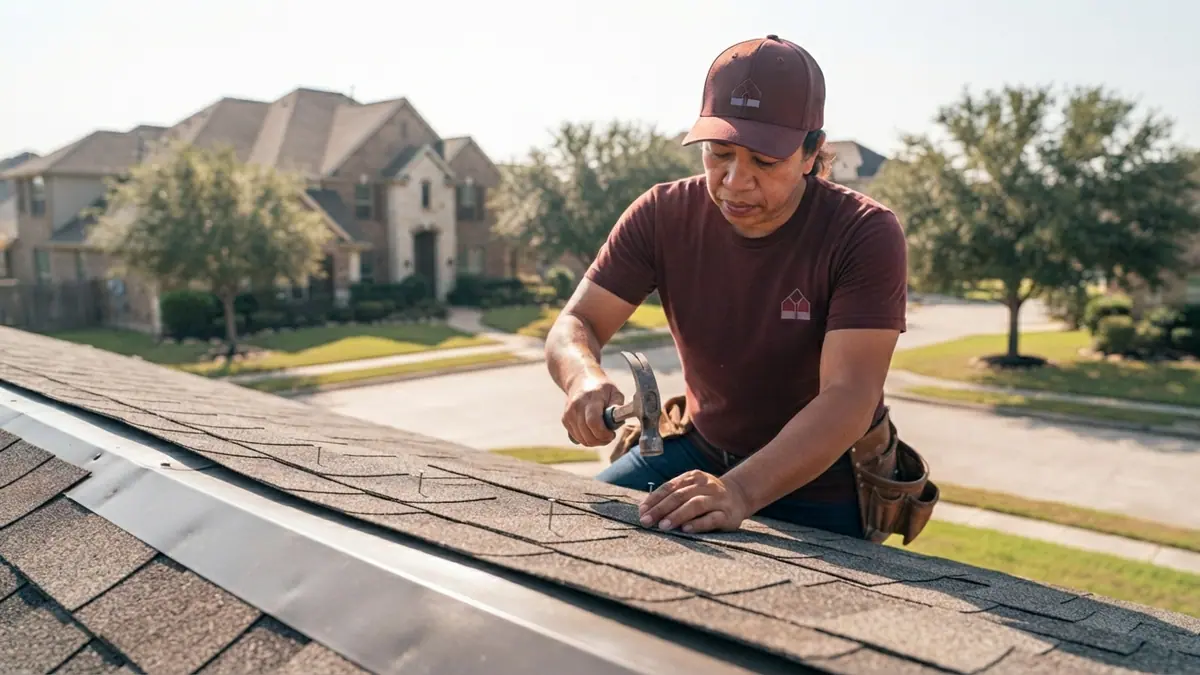
Not less than four per strip shingle, or two per individual shingle. The code sets that as the floor and then binds the manufacturer's instructions on top of it: where the shingle maker requires six, six becomes the enforceable number.
The fastener itself is specified too. Roofing nails must be galvanized steel, stainless steel, aluminium or copper, minimum 12-gauge shank with a head at least three-eighths of an inch across, long enough to penetrate through the roofing and at least three-quarters of an inch into the sheathing.
That gives you two precise questions for any quote: how many fasteners per shingle, and does that match what the chosen shingle's instructions require.
What else does the code pin down?
- Slope. Asphalt shingles need a slope of 2:12 or steeper. Between 2:12 and 4:12 the underlayment has to be doubled.
- Drip edge. Required at eaves and rakes, overlapped at least two inches where segments meet, extending a quarter inch below the sheathing and two inches back up the deck, fastened no more than twelve inches apart.
- The order nobody checks. Underlayment goes over the drip edge along the eaves and under it along the rakes. Reversing that is a common install error and it is visible from the ground once you know to look.
- Solid decking. Shingles must be fastened to solidly sheathed decks.
- No ice barrier. Fulshear's amendment sets the ice barrier requirement to "No", so the code does not call for one here.
What does Fulshear ban outright?
New wood shingles and wood shakes. The city deletes both of the code sections that would otherwise permit them, stating that no new wood shingles and no new wood shakes are permitted in the city. That is a genuinely local rule and it rules out an option roofers elsewhere in Texas still offer.
Does a Fulshear roof need a windstorm certificate?
No. The Texas Department of Insurance windstorm inspection programme covers the fourteen first-tier coastal counties plus parts of Harris County east of Highway 146. Fort Bend County is not among them, so the WPI-8 certification that applies to a coastal re-roof does not apply here.
That distinction matters when reading roofing advice written for Galveston or Brazoria. Those counties carry an inspection and certification requirement that a Fulshear job simply does not have.
Code compliance is easiest to verify on a full replacement, where the deck, underlayment, fastening and edge detail all go in at once under a permit. On a smaller shingle and flashing repair the same fastening and drip-edge rules still govern the section being opened.